
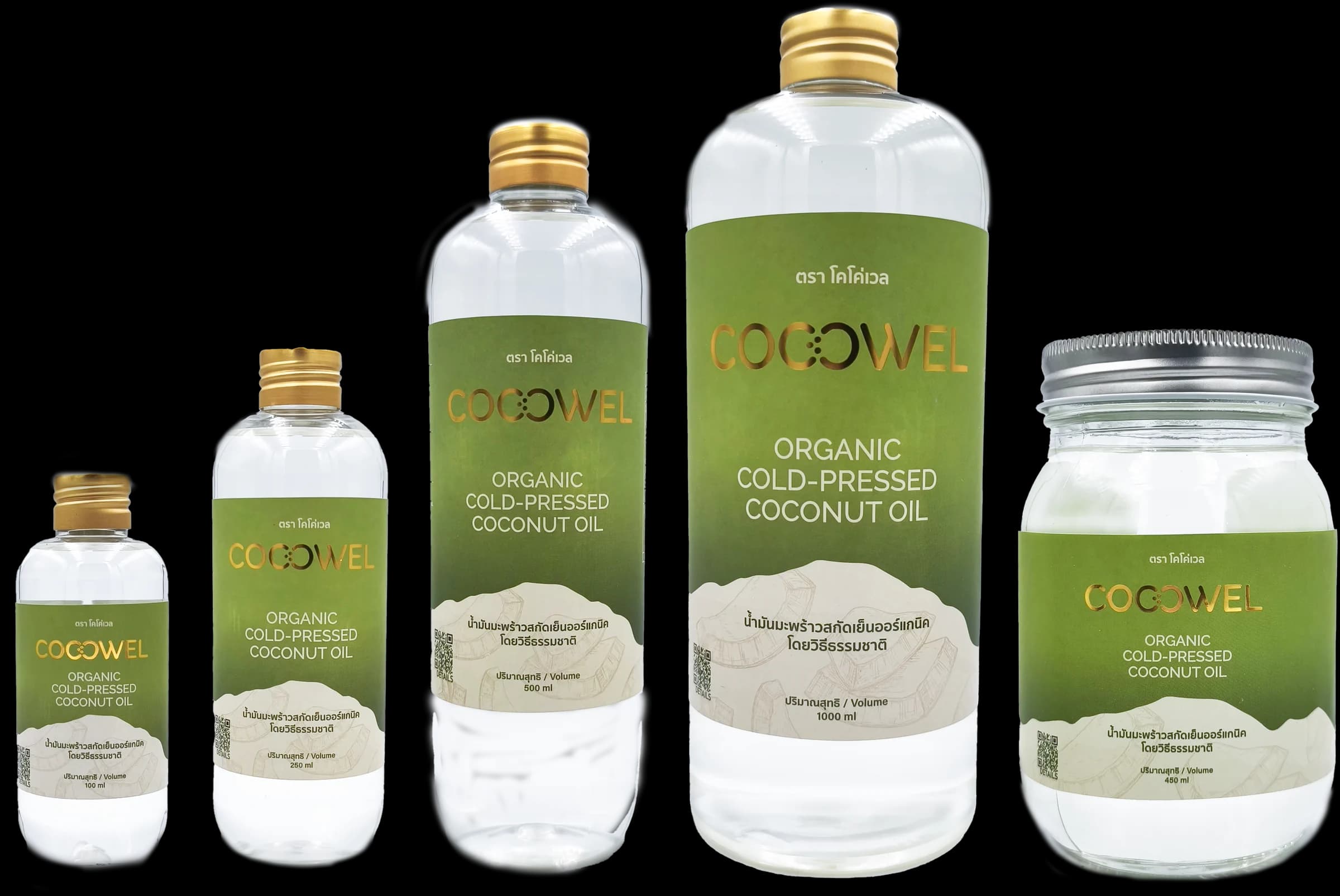
Organic cold-pressed
Coconut Oil
12 coconuts in one liter.
from ฿125
By COCOWEL · Published
Use coconut oil where heat and shelf life matter — sautéing, roasting, baking — and olive oil where its polyphenols and pepper-green flavour are the point, like salads and finishing. On our measured numbers, extra virgin coconut oil holds a higher smoke point than extra virgin olive oil (202°C vs a published typical 191°C) and carries 64.9 g of MCTs per 100 g, which olive oil doesn't have at all.
Smoke point is where an oil starts to break down visibly. Our extra virgin coconut oil was measured at 202°C by Central Laboratory (Thailand), report TRBK67/20255 — unusual for a virgin oil, and a direct result of vacuum-sealing that pulls moisture below 0.01 g per 100 g. Extra virgin olive oil is typically published around 191°C, refined olive oil higher.
In practice: both handle everyday sautéing. For roasting at 200°C or repeated pan use, coconut oil has more headroom before flavour degrades.
Coconut oil is about 93.7% saturated fat by structure (ALS Laboratory Group, lot 2461225) — the reason it is solid below roughly 24°C and extremely slow to oxidise. Olive oil is predominantly monounsaturated, the profile most associated with Mediterranean-diet research.
Neither structure is 'better' in the abstract; they do different jobs. Saturated structure resists heat and time. Monounsaturated structure brings the fatty-acid profile many nutrition bodies recommend for daily fat intake. A considered kitchen usually holds both.
64.9 g of every 100 g of our oil is medium-chain triglycerides — the C8, C10 and C12 fatty acids that are transported to the liver and converted to energy more directly than long-chain fats. Olive oil contains effectively none.
That's why coconut oil, not olive oil, shows up in morning coffee and pre-training routines. We state what is measured and leave performance claims to the sports-science literature.
Extra virgin coconut oil tastes like coconut — ours is never deodorised, so the aroma is part of the product. That's a feature in curries, baking and most Southeast Asian cooking, and a mismatch for, say, a Caesar dressing. Olive oil owns the cold applications.
If a recipe needs a neutral high-heat oil, refined oils win on invisibility — but at the cost of the processing our whole brand exists to avoid.
12 coconuts in one liter. Every figure in this article is measured on this product's own lots.