
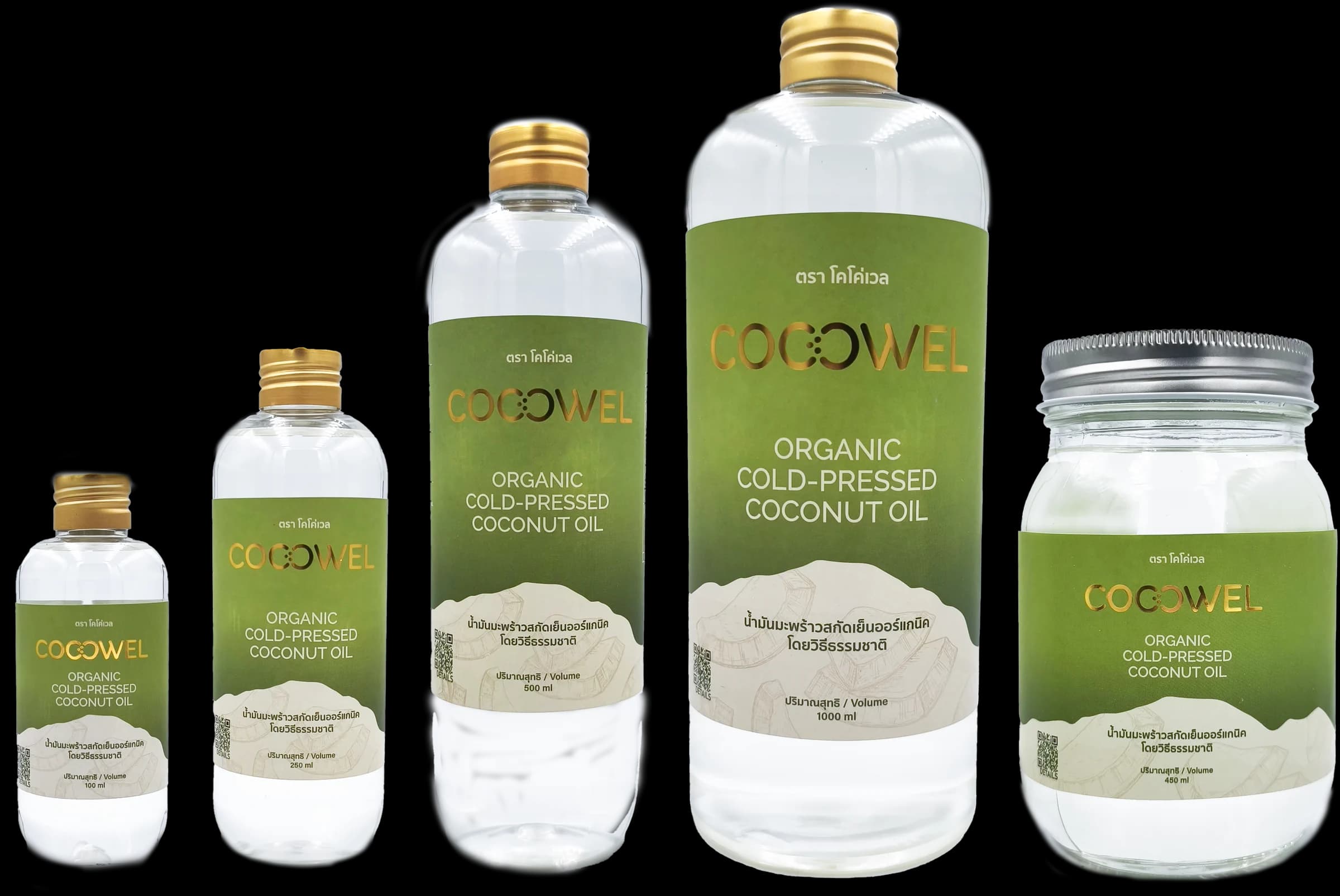
Organic cold-pressed
Coconut Oil
12 coconuts in one liter.
from ฿125
By COCOWEL · Published
Because it's drier. Smoke point falls as free fatty acids and moisture rise; our oil is vacuum-sealed until moisture measures below 0.01 g per 100 g, and Central Laboratory (Thailand) measured the smoke point at 202°C — report TRBK67/20255, April 2024. The 177°C you see elsewhere is the standard published figure for virgin coconut oil as a category, not a law of nature.
Heat any oil far enough and it starts to visibly break down — free fatty acids oxidise, glycerol degrades to acrolein, and the pan starts to smoke. The temperature where that begins is the smoke point. Past it, flavour deteriorates first, then the oil's structure.
Two things drag a smoke point down: free fatty acid content and water. Both are consequences of how an oil was made and stored, which is why the same species of oil can smoke at meaningfully different temperatures from different producers.
After cold pressing and centrifuging, our oil is vacuum-treated to draw out residual moisture — the same step that gives it a five-year unopened shelf life. The measured result on lot 2461225: less than 0.01 g of water per 100 g of oil.
Drier oil, later smoke. When Central Laboratory (Thailand) tested our extra virgin oil, it recorded 202°C — above extra virgin olive oil's typical 191°C, and 25 degrees above the figure most virgin coconut oils print.
Everyday sautéing happens around 160–180°C; oven roasting commonly runs at 200°C. At 202°C, our extra virgin oil covers both without crossing its limit — you keep the aroma of an unrefined oil in territory that usually forces a switch to refined ones.
One honest caveat: any oil, whatever its smoke point, degrades with repeated reuse. The measurement describes fresh oil, and we'd like it to stay describing yours.
12 coconuts in one liter. Every figure in this article is measured on this product's own lots.