
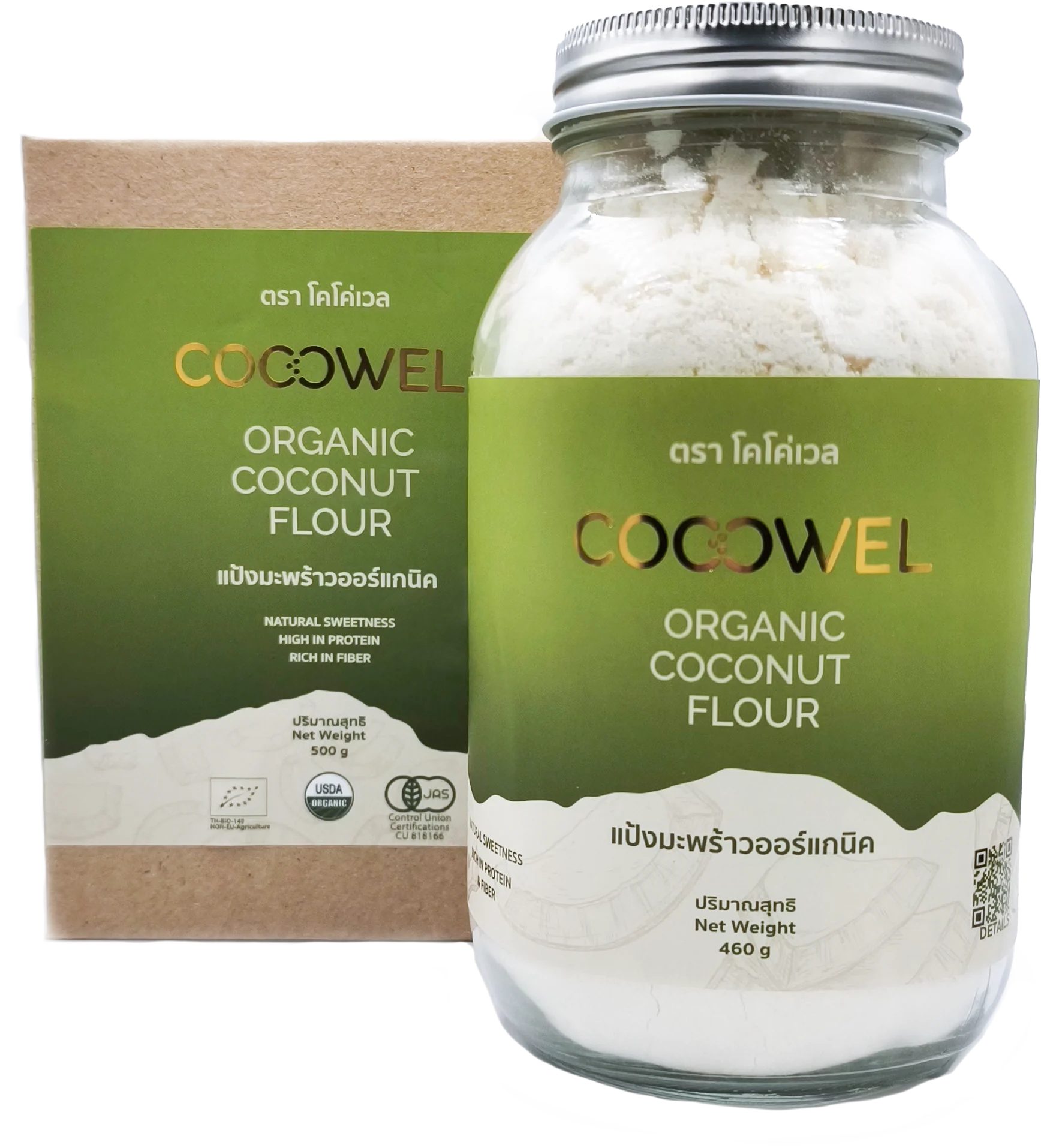
Virgin · Gluten-free
Coconut Flour
Forty-one percent fibre.
from ฿225
Start with three ratios. Swap up to 25 % of the wheat flour in a recipe you already trust, changing nothing else. Going to 100 %, count on roughly a quarter cup of coconut flour plus one extra egg for every cup of wheat flour you replace, and expect to add liquid. To thicken a sauce or a smoothie, one tablespoon is usually enough. All three follow from one measured number: 40.7 g of dietary fibre per 100 g.
Wheat flour is mostly starch with about 3 g of fibre per 100 g (a published typical value). Our coconut flour, milled from fresh meat, measures 40.7 g of fibre per 100 g on lot 21111262 — more than ten times as much. Fibre absorbs water and holds it, so the same volume of coconut flour takes far more liquid to become a batter, and there is no gluten to build structure once it does.
That is the whole reason a one-for-one swap fails. It is not a fault of the flour; it is arithmetic, and the fix is to change the ratio rather than the recipe.
The 25 % swap: replace up to a quarter of the wheat flour in pancakes, muffins or a quick bread with coconut flour and change nothing else. The extra fibre and a little natural sweetness come along; the structure still comes from the wheat.
The 100 % rule: for every cup of wheat flour a recipe calls for, use about a quarter cup of coconut flour and add one egg, then add liquid until the batter looks the way it should. This is a widely used starting point, not a law — recipes written for coconut flour already carry these adjustments, and they are the safer place to begin.
The thickener: one tablespoon stirred into a sauce, soup or smoothie thickens noticeably within a minute. Add it a spoon at a time; it keeps absorbing.
Pancakes are the friendliest first bake: eggs do the structural work anyway, so coconut flour, eggs and milk — with a pinch of our blossom sugar — make a low-carb breakfast without a recipe rewrite. Keep them small; they set softer than wheat pancakes and turn better at that size.
As a coating, coconut flour crisps well on fish, chicken or vegetable cutlets: dust, dip in egg, dust again. The fibre browns before it burns, and the coating stays on because it grips the egg wash.
Forty-one percent fibre. Every figure in this article is measured on the product itself — the lab lots are printed on the page.